The Radical Trinity
Revolution as Divine Communion

(These thoughts were originally written as 2 Facebook posts. I have been meaning to continue the series I began on the core commitments of The Church of the Revolution, which I began with the posting on war. That project is not moving along as easily as I hoped, but my busy brain has instead churned out these thoughts.)
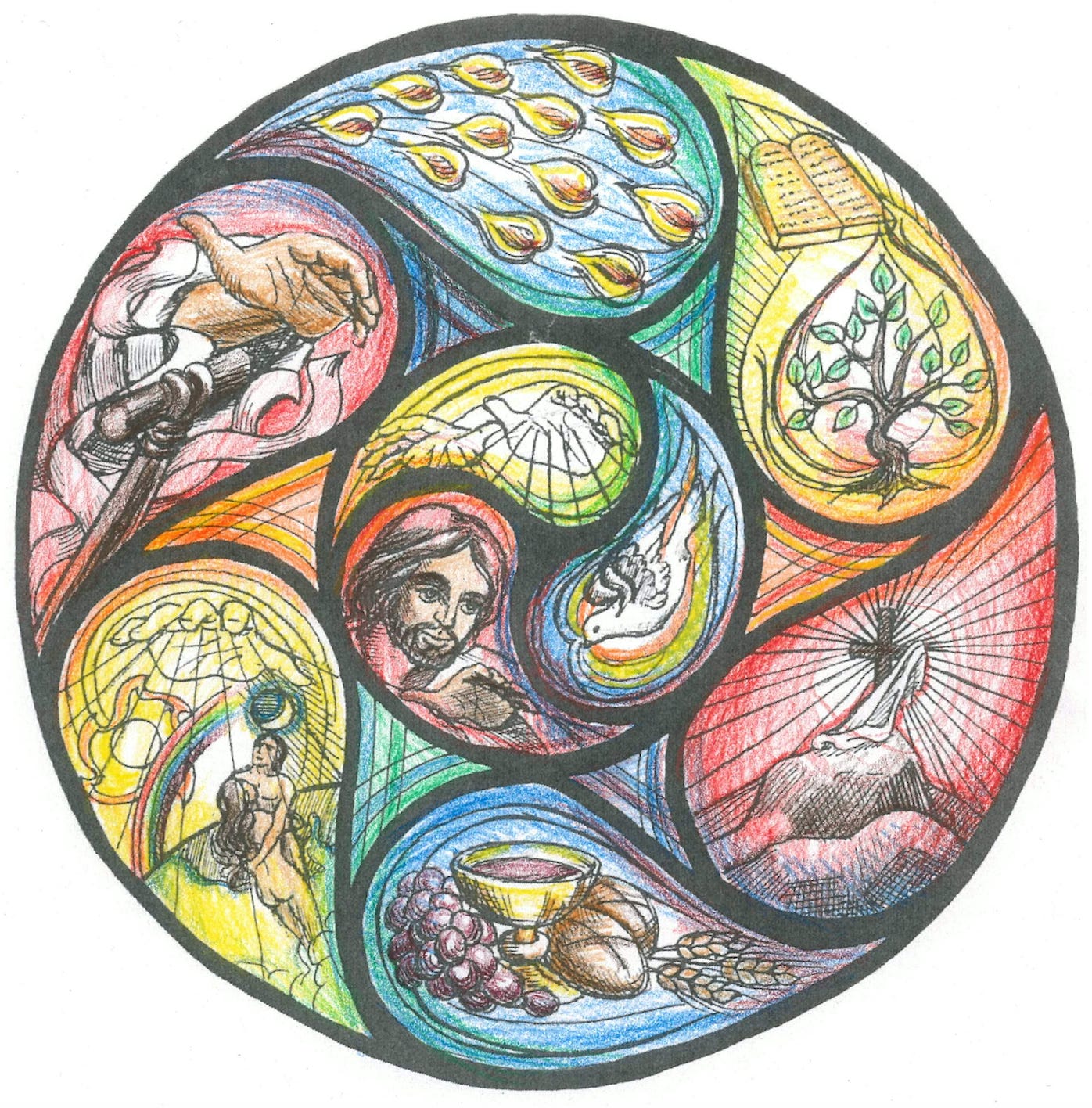
— The Radical Trinity
I've been a "social trinitarian" since reading The Trinity and the Kingdom by Jurgen Moltmann decades ago.
My take is that the Trinity really begins with two questions, what is God and how was Jesus manifesting God's relationship to him and the rest of humanity. In Eastern Orthodoxy, salvation isn't merely about going to heaven, but about becoming divinized in this life, the process of theosis.
Jesus, as the offspring of centuries of Jewish practice and history, accessed a higher realization of the movement of humanity towards theosis and in a literal sense incarnated that divinity within his life and ministry. How does the Creator and Spirit relate to this humanity of Jesus? I think classic theology is wrong when it places God outside of history and evolution. God is Evolution and History within Evolution.
So, my provisional Trinity is that the Cosmos and God are always One in Plurality. God doesn't preexist the Cosmos; the Cosmos is Infinite and is in a real sense God's eternal incarnation within Infinite Cosmic Space and Time.
Thus Jesus Christ was pre-existent as an infinite stream of evolutionary destiny that will continue to manifest into the infinite future.
We are invited into the incarnation via theosis.
So, I have Creator (Evolver) and Offspring (History). Spirit is the Fire, Energy, Power, and Heat of creativity within every moment of the Cosmic Unfolding.
I don't think of Creator, Offspring, and Energy (Fire) as three centers of consciousness, but as three relational infinite centerings within the immeasurable Divine Being.
—More Thoughts Written Later
As a Marxist Christian, I definitely get the class issues raised by professional theologians redefining the truth of Jesus in abstract philosophical terms.
All that said, I'm still a social trinitarian, in part, because I don't think early Judaism was monotheistic. The commandment, “have no other gods before me,” implies other gods. There's a growing scholarship that shows good evidence that early Judaism was actually henotheistic, ie, polytheist with one supreme God.
The question is really about whether the Trinity could be reconciled with the radical teachings of Jesus on solidarity and liberation for the poor and oppressed. I think it can, but I doubt I can make a succinct enough argument, but I will stab at it.
That Jesus was radically in solidarity with the poor seems historically valid, since the churches have repeatedly neglected to follow this through. If Jesus wasn't so radical, how did these sayings enter the canon? Did some later gospel writer invent them? Unlikely.
Jesus also seemed to be fully Jewish, though of a Galilean ethos. In the First Century, Judaism was very clearly monotheistic, with all extant writers emphasizing this doctrine. The original henotheism was suppressed.
However, the 4th gospel according to “John,” begins a pronounced ascent towards divinizing Jesus. This gospel also lacks reference to the anti-poverty teachings. Even Paul's letters tend to lack those concepts. Is divinizing Jesus part of the theological drift away from the radical Jesus? Sort of.
The divinizing of Jesus begins with the resurrection stories. These stories all have a fundamental precedent in Roman mythology, mashed up with Jewish scriptures. Romulus, the founding king of Rome:
“After a reign of thirty-seven years, Romulus is said to have disappeared in a whirlwind during a sudden and violent storm, as he was reviewing his troops on the Campus Martius. Livy says that Romulus was either murdered by the senators, torn apart out of jealousy, or was raised to heaven by Mars, god of war. Livy believes the last theory regarding the legendary king's death, as it allows the Romans to believe that the gods are on their side, a reason for them to continue expansion under Romulus' name.” (source: Wikipedia, et al).
The parallels with Jesus are obvious.
If the Roman gods deified Romulus and later Roman Emperors, how could an anti-imperialist movement *not* deify their founder? Using Jewish ideas of bodily resurrection (note 1 Cor. 15), Jesus was declared risen from the dead and ascending to the right hand of the One True God.
From there, the steps to deification are fairly simple. Jesus "must have" always been God. He was born of a virgin, just like Romulus, whose mother was a vestal virgin according to legend.
But, how to square that deity with stringent Jewish monotheism? The Arian controversy at the time of the Nicene Council reveals that Roman and Greek ideas of divinity were in combat with this monotheism.
All of that debate is history. Today, social trinitarianism has moved into the arena with a strong connection to left-wing theologians like J. Moltmann and L. Boff.
My take is somewhat different. The only God concept that makes sense, given my materialism, is pantheism - all being is divine. And that divinity is pluralistic, following William James, Grace Jantzen, and Mary-Jane Rubenstein.
To mesh the Trinity with pantheism is fairly simple as well, since naturalistic pantheists have insisted that the divine cosmos is truly pluralistic. The One and the Many are always interwoven.
My Trinity is Mother(Father)-Creator/Evolver, Child-Heir (History), and Spirit/Fire/Energy. A few years ago, I rewrote the Athanasian Creed as an exercise in thinking through these possibilities. I called the result, the Goddess Creed. I'll only post the opening lines, since I'm overdue to rewrite the whole thing.
We Adore Infinite Being as Goddess in Plurality, and Plurality in Unity; neither negating intrinsic Plurality, nor dividing the Unity.
#CommiePreacher